Study: Companies' Innovation Strength Satisfactory, but CXOs' Innovation Image Could Be Improved

A renowned survey by Dr Doeblin examined the innovative strength of the German economy, identifying strategic innovation communication and CXO positioning as key levers.
Wiesbaden, 19 February 2026 – Business journalists have an overall positive view of the innovative strength of the German economy, yet few managers are considered particularly innovative. This is revealed by a survey of 126 business journalists conducted by Dr Doeblin Gesellschaft für Wirtschaftsforschung on behalf of Fink & Fuchs AG.
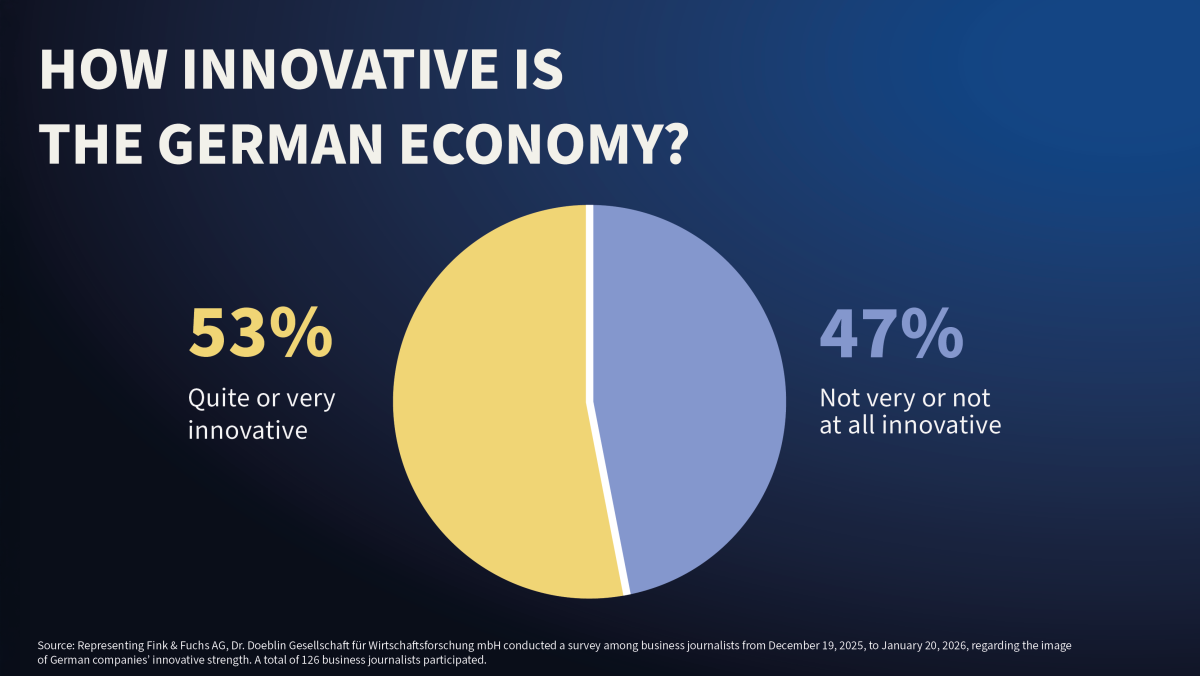
53 per cent of respondents rated the German economy as being either very or fairly innovative. By contrast, 47 per cent consider it to be not very or not at all innovative. Of particular note: Although business journalists can offer clear assessments of innovative small and medium-sized enterprises, comparatively few managers in those companies are regarded as innovative by journalists. Decision-makers are missing out on a significant opportunity here. This is because the factors that contribute to a positive image of innovation lie not only in the quality and visibility of innovations, but also in the people who embody this innovative strength.
Innovation levels are highly industry-specific
A look at the industries perceived as particularly innovative (multiple responses allowed) reveals enormous differences: The top three most innovative segments in Germany are mechanical and plant engineering (43 percent), chemicals/pharmaceuticals (40 percent) and family-owned businesses in general (28 percent).
With 27 percent, the digital economy ranks fourth. At a time when digital sovereignty is becoming an increasingly important issue for Germany and Europe, this creates opportunities for companies to strengthen their position.
The traditional key industry, the automotive sector, lags far behind in seventh place with only 21 percent. This reflects the crisis in the industry and the perception that its innovative momentum is driven by others.
There is room for improvement in CXO positioning.
Given the important role played by small and medium-sized enterprises (SMEs) in the German economy, it is worth taking a closer look at how their innovative strength is perceived. When asked who the most innovative executives at SMEs are, only a few managers are mentioned more frequently. Yet, especially in SMEs, executives are exemplary representatives of innovative strength and corporate culture. This low visibility suggests a strategic gap in CXO positioning.
Success stories are most effectively told through the lens of key figures. The media seeks out influential individuals who can provide context, take a stand and help shape the conversation. Clear CXO positioning can directly contribute to a company’s reputation for innovation and its overall image.
‘As thought leaders, executives can embody their company’s innovative strength and thereby build a lasting reputation,’ says Alexandra Groß, CEO of Fink & Fuchs AG. ‘Positive narratives are crucial for strengthening economic confidence, both for individual companies and for the country as a whole.’
Germany possesses innovative strength, but lacks a consistently positive image of innovation. Strategic innovation communication is key to making actual successes visible and being perceived as a leader in international competition.
Rather than focusing solely on individual products or features, the focus should be on an overarching narrative that situates innovations within economic and social contexts, thereby giving them meaning. The same applies to CXO positioning: media professionals are looking for success stories illustrated by charismatic executives who set the agenda, provide context and address sensitive issues with courage.
The top three innovative SMB companies
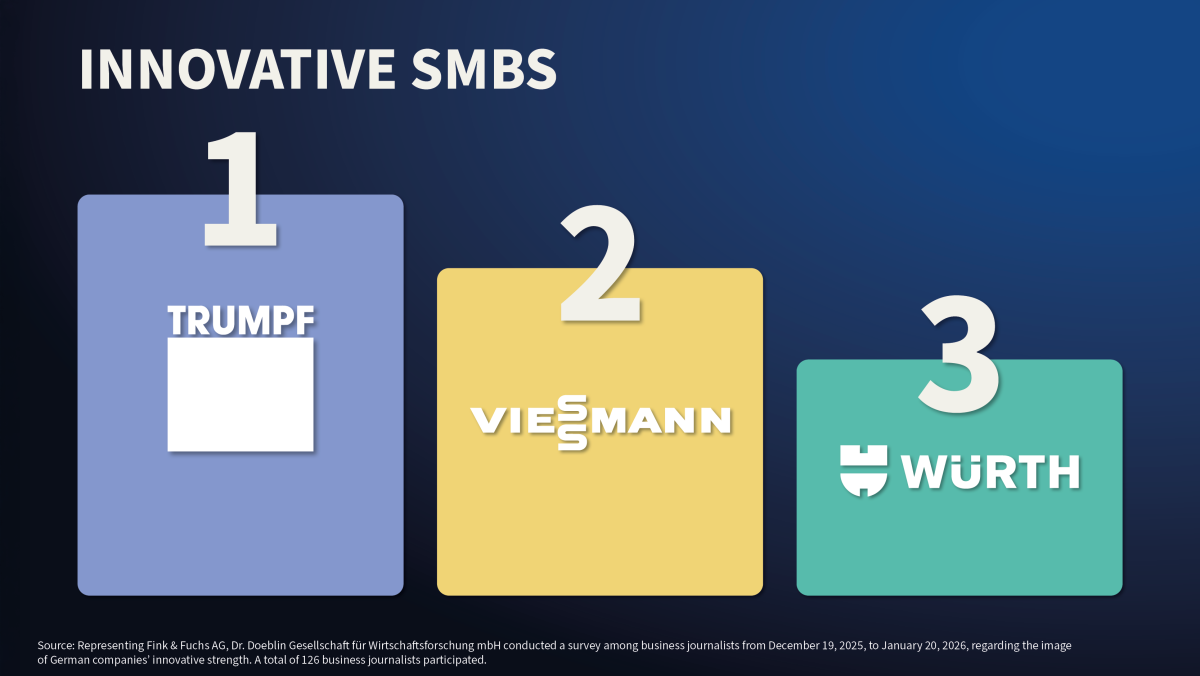
Trumpf, Würth, and Viessmann make up the top three. According to respondents, the decisive factors are the interplay of technological excellence, strategic foresight, stability, and compelling communication.
These results are no coincidence. Trumpf’s communication strategy focuses on technological leadership, innovation successes, and tradition. The focus is not on individual products, but on building an overarching reputation for innovation that engages with discourse at economic and political levels, positioning the company within that context.
The Federal Association of Communicators (BdKom) presented Trumpf’s communications team with the ‘Team of the Year’ award in recognition of their successful combination of employee engagement, technological communication and CEO communication. CEO Nicola Leibinger-Kammüller, in particular, consistently takes a clear stance, including in social and political debates.
Würth’s communications combine continuity with a forward-looking approach, emphasising digitalisation narratives. B2B communication focuses on a core set of clear storylines and the company’s role in the economic ecosystem. Reinhold Würth and Benjamin Würth prominently represent the themes of generational transition, responsibility, and values — even though they are not part of the Group’s executive leadership, but rather of the overarching governing body, in their roles as Chairman of the Foundation Supervisory Board and Honorary Chairman, respectively.
In 2025, Viessmann was one of the most prominent players in German industrial communication. The company communicated at the thought leadership level, integrating technology communication with an overarching societal perspective on topics such as the heating transition. In 2025, the company received the Thought Leadership Award from UNICEPTA as part of the German PR Award.
The jury was impressed by the company’s constructive, credible and socially relevant communication, which conveyed a clear and positive message. The next award went to Byung-Hun Park, Viessmann’s Vice President of Corporate Communications. He was named Communicator of the Year by the PR Report Awards jury in 2023.
“These companies are united by the fact that they act and showcase their innovative strength strategically,” said Groß. “They demonstrate that reputation is the result of consistent communication efforts.”