Germany’s Startup Boom Continues as New Business Creation Reaches Record High

At a Glance
Germany’s startup ecosystem is gaining momentum. In the first half of 2026, 3,053 new startups were founded—a 52% increase compared with the second half of 2025, according to data from the German Startup Association. Artificial intelligence is a major driver of this growth, with more than one in three newly founded companies focused on AI.
Despite ongoing challenges facing many established industries, Germany’s startup landscape tells a different story. The country has never recorded more startup formations in the first half of a year than it did in 2026.
Between January and June, entrepreneurs launched 3,053 new companies—more than were founded during the entire year of 2024. Startup creation has now increased for three consecutive half-year periods, with June 2026 setting a new monthly record of more than 600 newly established startups.
AI Is Driving the Next Wave of Entrepreneurship
Artificial intelligence is emerging as one of the strongest growth engines behind Germany’s startup boom.
Around 34% of all newly founded startups have an AI focus, making it the most significant technology trend in the current wave of entrepreneurship. While software remains the country’s largest startup sector, founders are also increasingly launching businesses in healthcare, life sciences and food technology.
The figures highlight AI’s growing role—not only as a technology, but as a catalyst for innovation across industries.
Startup Activity Expands Beyond Berlin
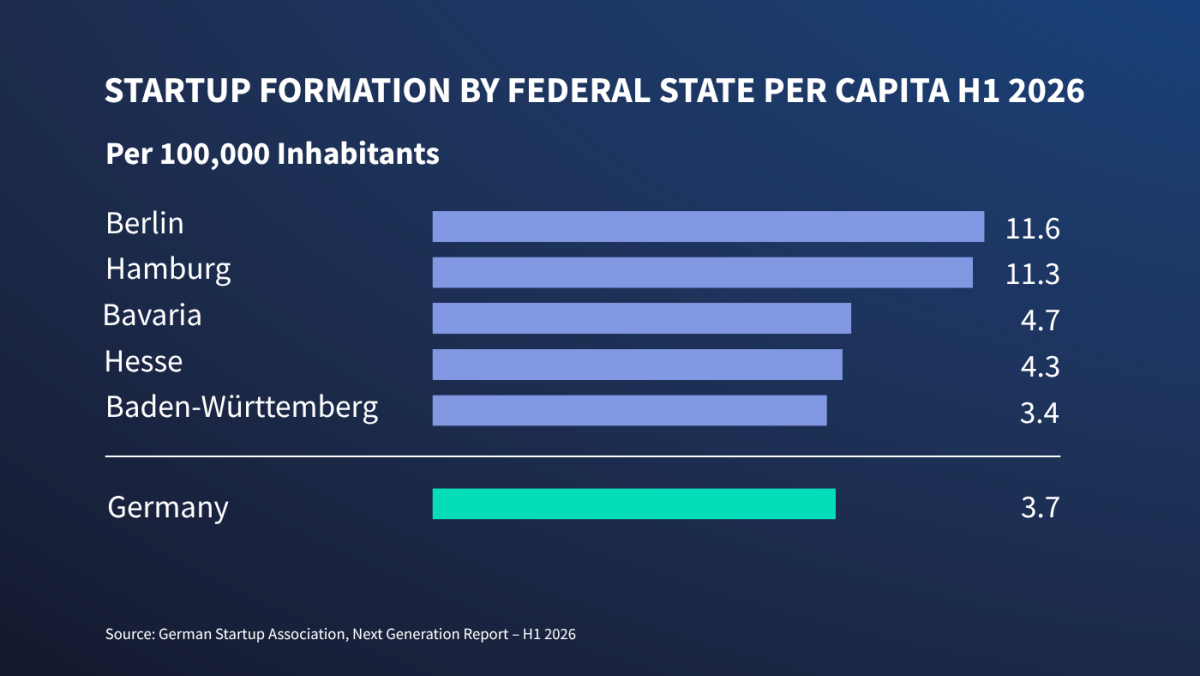
Startup creation is increasing across all German states.
Measured on a per-capita basis, Berlin continues to lead, followed by Hamburg, Bavaria and Hesse. Although Berlin remains Germany’s largest startup hub with 429 new companies founded during the first half of the year, its growth is now below the national average, narrowing its long-standing lead.
The data suggests that Germany’s startup ecosystem is becoming increasingly decentralized, with innovation spreading across multiple regional hubs.
Munich Leads Germany’s Startup Cities
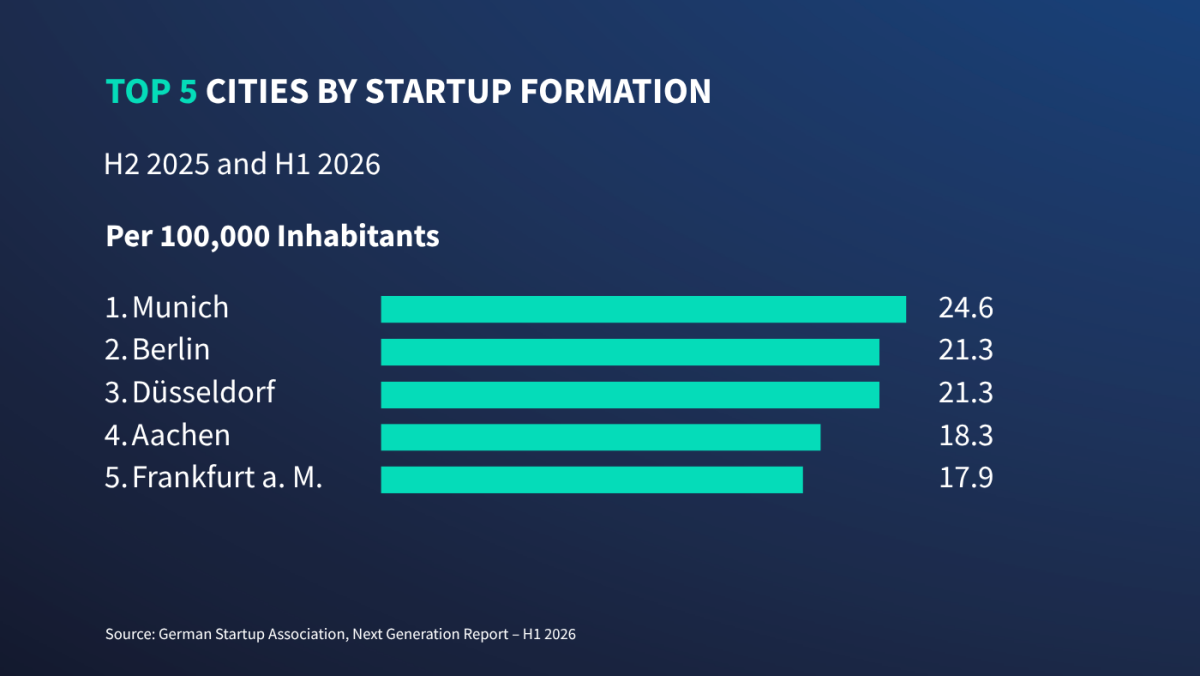
At the city level, Munich now records the highest number of startups per capita, retaining its leading position ahead of Berlin.
Frankfurt and Hamburg made the biggest gains in the latest city rankings, climbing from 12th to 5th place and from 11th to 6th place, respectively.
Germany’s ten strongest startup cities are now:
• Munich
• Berlin
• Düsseldorf
• Aachen
• Frankfurt am Main
• Hamburg
• Potsdam
• Karlsruhe
• Cologne
• Heidelberg
A common pattern emerges across these locations: thriving startup ecosystems tend to develop around leading universities and research institutions. Increasingly, these innovation clusters are no longer concentrated in a handful of regions but are distributed across Germany.
Germany’s Unicorn Landscape Continues to Grow
The positive trend extends beyond startup formation.
Germany is also producing more unicorns—privately held startups valued at more than US$1 billion. Since the end of 2020, the number of German unicorns has grown from 11 to 36, with six new companies reaching unicorn status in 2026 alone.
Importantly, several of these high-growth companies are based outside the country’s traditional startup hotspots, reflecting the increasing maturity of Germany’s broader innovation ecosystem.
Despite funding conditions that remain more challenging than in markets such as the United States, entrepreneurial momentum in Germany shows no signs of slowing.
Why Communications Matter More Than Ever
Building a successful startup requires more than an innovative product or breakthrough technology.
Communications play a critical role in helping young companies establish visibility, build credibility and earn the trust of customers, investors, partners and other key stakeholders.
As competition for attention continues to intensify, startups need a clear positioning, compelling storytelling and consistent messaging to differentiate themselves in the market.
Strategic communications are no longer a nice-to-have—they are an essential growth lever. Founders who invest early in building reputation and thought leadership are better positioned to attract investment, recruit talent and accelerate long-term business success.