AI Disclosure Requirements from August 2026: What Companies Need to Know About AI-Generated Images and Content
At a Glance
Starting on 2 August 2026, the EU AI Act introduces new transparency requirements for the use of generative AI. However, not every AI-generated image or text must be disclosed. Whether disclosure is required depends on how content is presented, whether it could be perceived as authentic, and whether humans retain editorial responsibility. For organizations, the key priority is establishing clear governance, review processes and disclosure guidelines.
Does Every AI-Generated Asset Now Require a Disclosure?
This is one of the questions communications teams are asking most frequently.
Today, AI supports a wide range of corporate content creation—from drafting press releases and LinkedIn posts to generating product visuals and enhancing videos. At first glance, the new EU AI Act could therefore appear to require disclosure for almost every AI-assisted piece of content.
In practice, however, the regulation takes a more nuanced approach.
Rather than focusing on whether AI was used, the Act considers how the content may be perceived by its audience and whether appropriate human oversight has been applied.
Could an image reasonably be mistaken for a real photograph? Has AI-generated text been published without meaningful human review or editorial responsibility?
These questions—not the AI tool itself—determine whether disclosure is required.
For communications professionals, this means the obligation is driven by the use case, not by the technology.
When Must AI-Generated Images, Videos or Audio Be Disclosed?
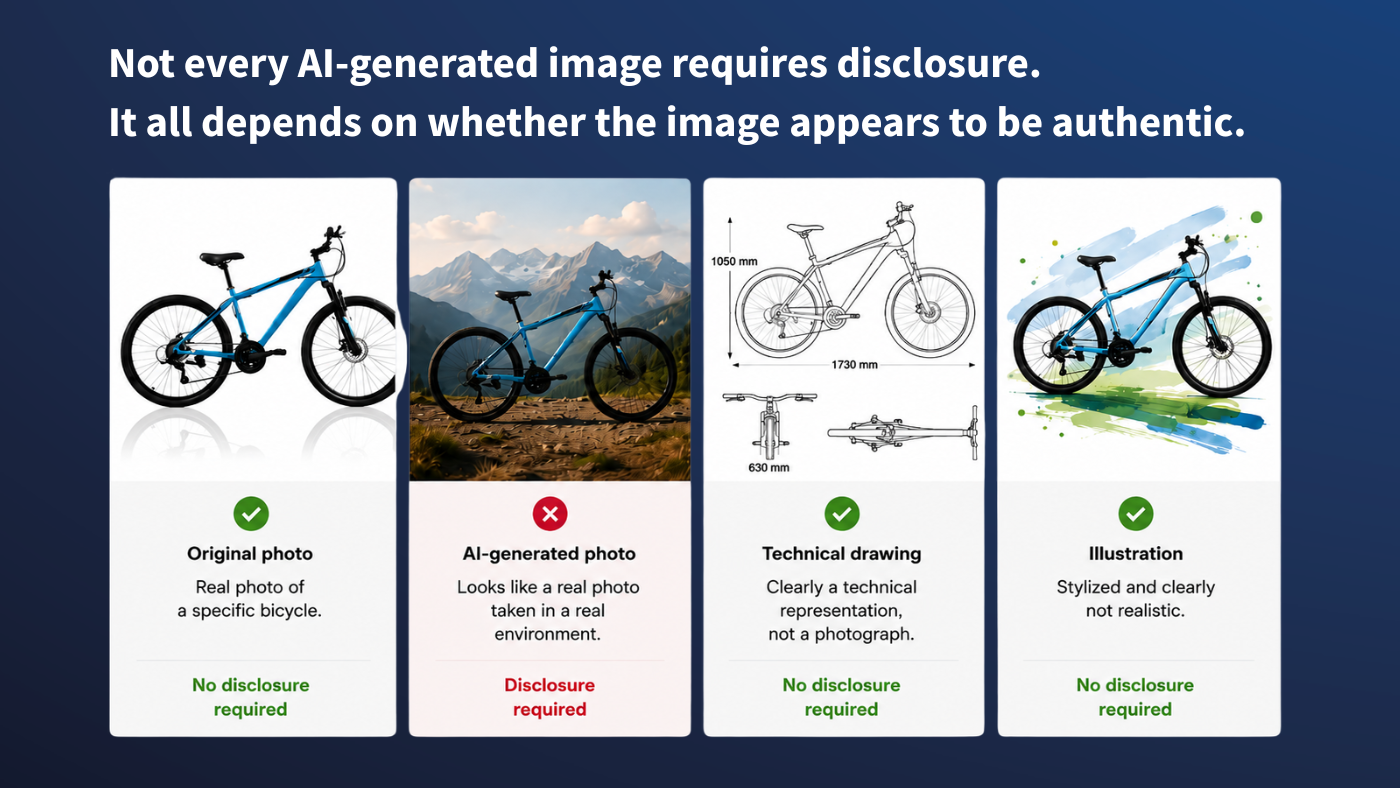
Under the EU AI Act, disclosure may be required whenever AI-generated or AI-manipulated visual or audio content depicts real—or realistically portrayed—people, objects, places or events in a way that could lead audiences to believe the content is authentic.
The underlying principle is straightforward: if there is a realistic risk of misleading viewers about the origin or authenticity of the content, transparency becomes essential.
A Simple Three-Step Test
Before publishing AI-generated visual content, communications teams should ask three questions:- Was the content created or substantially modified using AI?
- Does it depict a real or realistically portrayed person, object, place or event?
- Could audiences reasonably believe the content is authentic?
If the answer to all three questions is yes, disclosure will generally be required.
Practical Examples for Corporate Communications
| Use Case | Disclosure Required? | Assessment |
| AI-generated employee portrait | Yes | Images of people carry a particularly high risk of misleading audiences. |
| AI-generated product photo in a realistic setting | Usually yes | The image could easily be perceived as an authentic photograph. |
| AI-generated illustration | Usually no | Its artificial nature is generally obvious. |
| Data visualizations or charts | No | The issue is not whether the graphic was AI-assisted, but whether it depicts reality. |
| AI-generated image of a trade show that never took place | Yes | The image creates the impression that a real event occurred. |
| Technical rendering or conceptual illustration | No | These visuals are not typically perceived as documentary or photographic evidence. |
Where Should AI Disclosures Appear?
Knowing whether to disclose AI-generated content is only part of the equation. Equally important is how and where that disclosure is presented.
The disclosure should appear where audiences first encounter the content.
For images and videos, relying solely on a caption or social media post may not be sufficient, as captions can be separated from the visual itself depending on the platform or user interface.
A more reliable approach is to integrate the disclosure directly into the image or video. For audio content, the disclosure should ideally be included at the beginning of the recording.
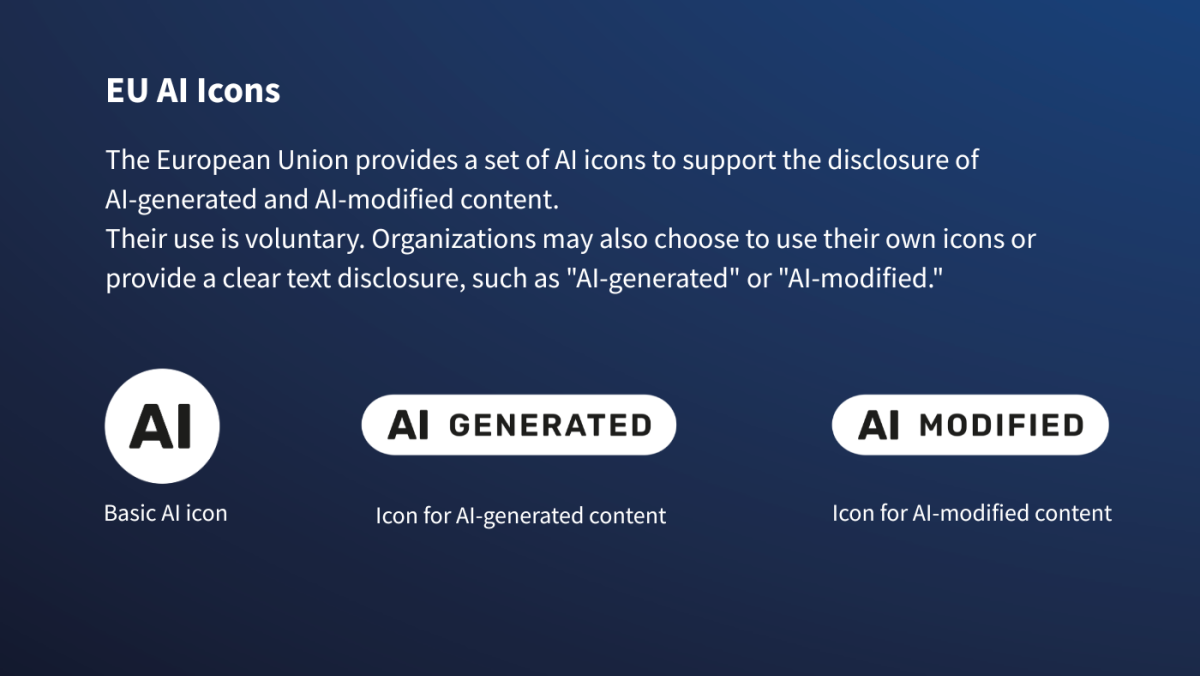
Simple wording such as “AI-generated” or “This image was created using artificial intelligence” is generally appropriate, provided it is clearly visible and easily understood.
What About AI-Generated Text?
Different rules apply to text-based content.
Not every blog post, LinkedIn article or press release drafted with ChatGPT or another AI assistant must be disclosed.
Under the EU AI Act, disclosure is generally required only if all of the following conditions are met:- the text was generated or substantially modified using AI,
- it is published,
- it relates to a matter of public interest, and
- it is published without meaningful human review or editorial responsibility.
For corporate communications, the final criterion is often the most important.
Human Editorial Responsibility Means More Than Proofreading
Many organizations now use generative AI as a sparring partner for brainstorming, structuring ideas or producing first drafts. There is nothing inherently problematic about this approach.
What matters is that people remain responsible for the final published content.
Organizations should therefore establish clear internal processes to ensure that AI-assisted content is:
- reviewed for factual accuracy,
- checked against reliable sources,
- assessed for sound reasoning and appropriate conclusions,
- revised where necessary, and
- formally approved before publication.
Whether the final version differs substantially from the AI-generated draft is ultimately less important. What matters is that a genuine editorial review has taken place.
A simple spell check or grammar review is not sufficient.
These governance principles are good communications practice regardless of the EU AI Act. Many organizations already apply similar quality assurance standards as part of their existing editorial workflows.
Practical Examples
| Use Case | Disclosure Required? | Assessment |
| ChatGPT creates a first draft, which is reviewed and approved by the communications team | Generally no | Human editorial responsibility remains with the organization. |
| A specialist article is published fully automatically without human review | Yes | No meaningful human oversight has taken place. |
| A press release is drafted with AI support, then edited and approved | No | Human review and approval ensure editorial responsibility. |
| An AI-generated LinkedIn post on a topic of public interest is published without review | Likely yes | Editorial oversight is missing. |
Why Companies Should Review Their AI Governance Now
For most organizations, the real challenge is not deciding whether to disclose individual pieces of content. It is creating a clear, consistent and well-documented decision-making process.
Rather than automatically labeling every AI-assisted asset, communications teams should assess each publication against a few key questions:
- Could the content reasonably be mistaken for authentic? For images, videos and audio, the potential to mislead is the decisive factor.
- Does the content address a matter of public interest? This question is particularly relevant for AI-generated text.
- Has the content been reviewed and formally approved? A clearly identified individual should retain editorial responsibility.
- If disclosure is required, will audiences notice it immediately? Disclosures should be placed where they are clearly visible at the point of first contact with the content.
To ensure these decisions remain consistent over time, organizations should embed AI governance into their existing content creation and approval workflows rather than treating it as a separate compliance exercise.
Key Takeaways
The EU AI Act does not require blanket disclosure of every piece of AI-assisted content.
Instead, it introduces transparency obligations where audiences could be misled about the origin or authenticity of published material. In practice, this means integrating generative AI into established editorial, review and approval processes rather than creating entirely new workflows.
Organizations that define clear responsibilities, implement robust review procedures and apply disclosures where they are genuinely required will not only meet regulatory expectations. They will also strengthen the credibility of their communications and build trust with increasingly AI-aware audiences.
Ultimately, these governance principles represent more than regulatory compliance—they reflect good communications practice. Publishing AI-generated content without meaningful review should already be prevented by sound quality assurance processes, just as clear disclosure should be standard practice whenever realistic AI-generated visuals have the potential to mislead.